
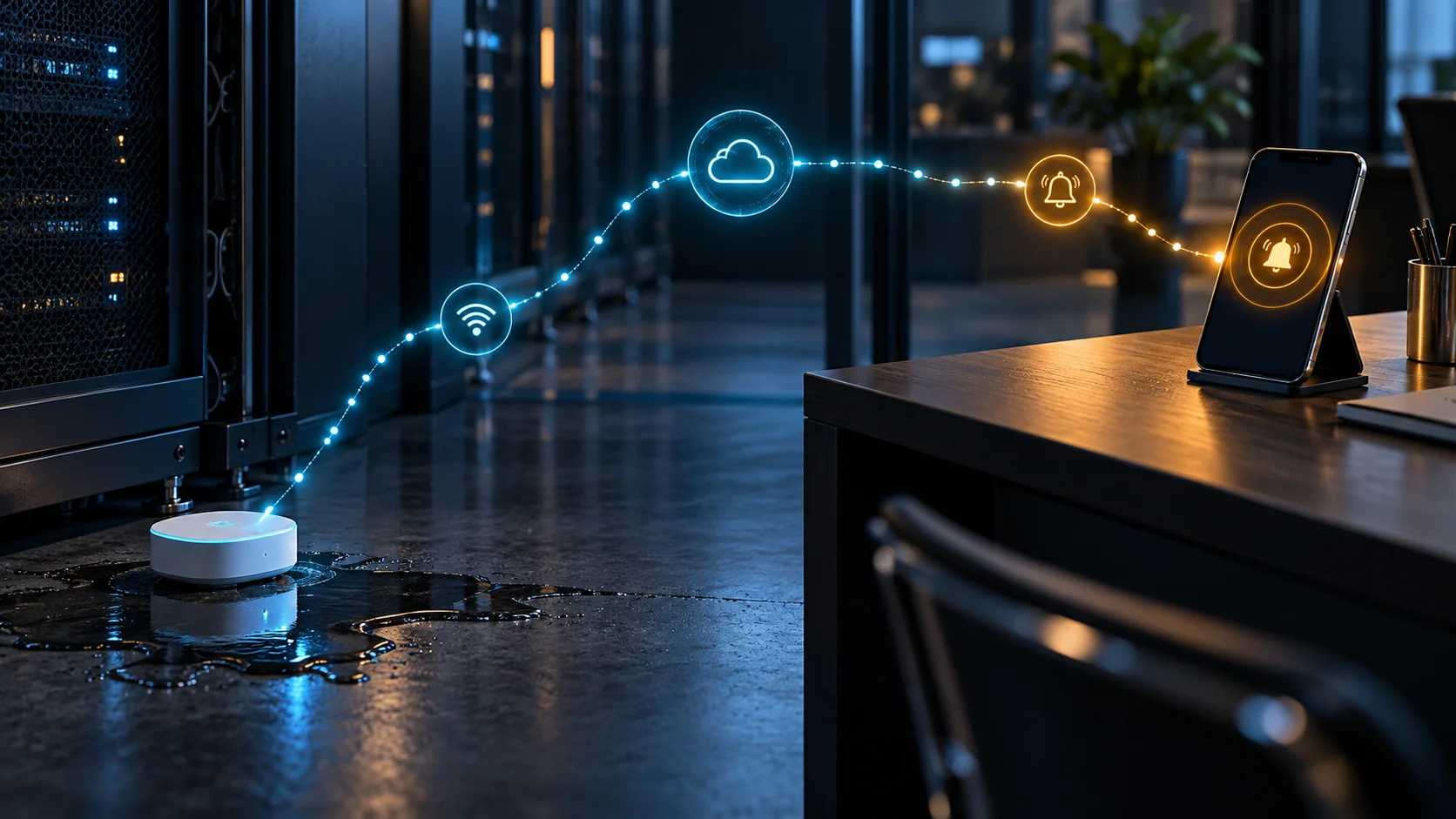
The short answer
Test the loss of monitoring as carefully as the condition being monitored. Record when a sensor last reported, how a missing check-in is detected, who receives that warning and how you prove the device has recovered. A quiet dashboard is useful only when you know the watch is still on duty.
A quiet dashboard can mean two very different things
The room may be dry, cool and perfectly ordinary. Or the sensor may have stopped reporting while its dashboard politely displays yesterday's reassuring value. Those situations look surprisingly similar when nobody has defined what stale data means.
Our earlier facility-sensor article covered choosing conditions and routing alerts. This edition goes one level deeper: a commissioning drill for the monitoring system itself. Before a busy season or a holiday closure, ask the team to demonstrate what happens when the watch goes silent. Even a Jedi should check whether the lookout's communicator has a battery.
Write down the monitoring promise
Choose one noncritical pilot device. Record its location, business purpose, reporting interval, last-seen time, power source, gateway, network path and notification destination. Name the operational owner and the person who maintains the technology. Those may be different people.
Agree how long a missing report can remain unnoticed for this particular use. A frequently reporting sensor and a battery-powered device that checks in occasionally need different rules. Set a missing-data threshold based on the service's supported behavior and the business consequence. Do not copy a timeout from a different product and call it a standard.
Separate three states: a normal current reading, an abnormal condition, and an unknown condition because data is stale. The unknown state needs an explicit response. It must never inherit the green color simply because the last good measurement was comfortable.
Run three controlled failure tests
First, use the vendor's supported test method to simulate an abnormal condition. Avoid creating a real leak, overheating equipment or interrupting safety systems. Record when the test began, when the platform detected it, when the notification arrived and who acknowledged it. A screenshot of a configured rule is not a delivery receipt.
Second, simulate a missing device on the isolated pilot. Use a supported test mode or a planned temporary disconnection that the owner approves. Confirm that a missing-check-in warning appears within the agreed window. If the product cannot report device loss, document that limitation and decide whether an independent health check or another design is needed.
Third, test the pilot gateway or network dependency without touching shared production connectivity. A single gateway may hide several devices at once. Ask whether the platform can still notify someone when that path fails, and whether a power or internet failure also disables the notification route. Do not discover a shared dependency during the incident it was supposed to report.
Prove the handoff, then prove the return
Use the actual on-call arrangement, with a clearly labeled planned exercise. Can the recipient identify the room and device? Can they get into the space? If they are unavailable, does the documented backup receive the escalation? Agree on a response target and record the measured result rather than inventing a universal five-minute promise.
Restore the pilot to normal operation. Verify a fresh reading and current last-seen time, not just the disappearance of an error badge. Confirm whether the notification needs acknowledgment or manual closure. Record any buffered readings, duplicate messages or uncertain intervals so the next person understands what happened.
An alert that clears itself is not proof that a person checked the room. Keep the technical recovery and the operational decision distinct. The Force is a fine story device; a named owner is a better escalation policy.
Include the security and support questions
NIST's IoT capability baseline is a useful starting point for evaluating device protections. It addresses identification, configuration, data protection, interface access, software updates and cybersecurity-state awareness. It does not certify your installation or establish the correct timeout for a leak sensor.
Ask the supplier how devices are identified, who can change alert rules, how updates are delivered, what support ends when, and what you can export if you change providers. Review access to the dashboard and notification integrations. A monitoring service should not become a forgotten administrator account with a subscription.
Keep device-health monitoring and cybersecurity monitoring connected to the people who can act on them, while documenting the limits of each. A device can be online and insecure, or secure and temporarily unreachable. One green icon cannot answer both questions.
Keep a one-page acceptance record
Capture the device and location, expected check-in interval, missing-data threshold, test method, timestamps, recipients, acknowledgment, recovery evidence, exceptions, owner and next review date. Store the record with the operational documentation. Keep passwords and recovery secrets somewhere appropriately controlled.
Repeat the relevant checks after changing a gateway, internet service, notification address, building layout or response owner. Review battery and support schedules using the supplier's guidance. The purpose is not to manufacture paperwork; it is to preserve the evidence that the whole path worked after the last meaningful change.
For this week's team discussion, choose one sensor and ask for a demonstration of all three states: normal, abnormal and unknown. If nobody can show the unknown state, you have found the next practical improvement before the building finds it for you.
Common questions
Does no alert mean that everything is normal?
No. Confirm that readings are current and device-health checks are working. Missing or stale data should be treated as an unknown condition with a defined response.
How quickly should a missing sensor trigger a warning?
Use the device's supported reporting behavior and the business consequence to agree a threshold. Test that threshold on a noncritical pilot; there is no single timeout suitable for every sensor.
Should we unplug production equipment to test monitoring?
Use vendor-supported simulation or an isolated, approved pilot. Do not interrupt shared production connectivity, safety systems or critical equipment to run this checklist.
What proves that monitoring has recovered?
Verify fresh readings, current last-seen information, the correct alert state and the operational owner's acknowledgment. Record unresolved data gaps and any manual closure steps.
Sources and implementation notes
Sources checked October 29, 2026. The operating checklist above is Comnexiom guidance; configure and test it for your own systems.
How Comnexiom helps
Review a monitoring pilot with our IoT crew. Start with one location, a supported test procedure and a named response owner. Read the facility monitoring overview for the broader design questions.
Back to Jedi Tales ↗